


 Services


Introduction
A finance ai agent is software that completes multi-step finance tasks, such as invoice matching, journal entry drafting or variance analysis, with minimal human input at each step. It matters because lean finance teams reclaim hours only when the agent works inside the controls that protect the books. Trintech reports that labor costs associated with journal entries are reduced by over 70% Prnewswire with AI-driven journal entry automation. Most vendor demos never name the task that changed hands, so teams automate too little to matter or hand over controls-sensitive work with no approval gate. This guide names seven tasks an agent takes over in accounts payable (AP), month-end close and FP&A, and where a person still signs off. Start with our AI for Office of the CFO service if you want the build approach first.
Quick answer: A finance ai agent drafts, matches and flags work across AP, close and FP&A. A human reviews exceptions and approves before anything posts to the ledger.
Key Takeaways
- Filter every AP, close and FP&A task for clear rules and a defined exception path before choosing an agent.
- Require an audit trail and a human approval gate on any agent that touches journal entries or reconciliations.
- Start with one workflow, such as invoice matching, and measure labor hours reclaimed before you expand.
- Ask each vendor how the agent handles exceptions, not only clean transactions, because exceptions are where projects stall.
- Phase the rollout over 90 days instead of deploying across the whole finance function at once.
The 7 Tasks a Finance AI Agent Automates
A finance ai agent automates seven recurring tasks across three workflows: three in AP, three in the close and one in FP&A. Each task ends with a human approval before anything posts.
-
Invoice capture. The agent reads incoming invoices and extracts vendor, amount and line items.
-
Three-way matching. The agent compares each invoice against the purchase order and the goods receipt.
-
Exception routing. The agent flags mismatches and sends them to the right approver.
-
Journal entry drafting. The agent prepares recurring and accrual entries for review.
-
Account reconciliation. The agent matches ledger balances to bank and subledger data.
-
Variance flagging. The agent compares the period to prior periods and flags unusual movements.
-
Scenario modeling and board commentary. The agent pulls multi-system data, builds a first-pass model and drafts the narrative.
| Workflow | Tasks automated | Count | What the human still owns |
|---|---|---|---|
| AP | Invoice capture, three-way matching, exception routing | 3 | Approving exceptions and releasing payments |
| Close | Journal entries, reconciliation, variance flags | 3 | Reviewing and posting entries, close sign-off |
| FP&A | Scenario modeling and board commentary | 1 | Setting assumptions and owning the narrative |
What Does an AI Agent in Finance Do in the Monthly Close
An ai agent in finance assembles the close so the accountant reviews finished drafts instead of building them. It drafts journal entries, runs reconciliations and surfaces variances against prior periods. The controller then reviews, adjusts and posts.
The agent removes data assembly, not the sign-off. This is the answer SMB owners ask for most: the repetitive preparation moves to software and the judgment stays with a person. This is also the practical ai use in finance today, where the value sits in preparation rather than decisions.
Can You Trust an AI Agent for Finance With Controls-Sensitive Tasks
Yes, when the deployment has access permissions, audit logging and a mandatory human approval step. An ai agent for finance that drafts a journal entry is not the same as one that posts it. Treat any vendor pitch that skips this distinction as incomplete.
Segregation of duties applies inside an agentic workflow exactly as it does for a human team. The agent prepares. A controller or CFO approves. Read our controls-first framework for CFOs for the full control checklist.
Agentic AI for Finance vs Traditional Automation
Agentic ai for finance makes sequential decisions across a multi-step task, while rules-based automation executes one fixed rule. An agent reads an invoice, decides whether it matches a purchase order, decides how to handle a discrepancy and routes the exception. Nobody writes a rule for every branch in advance, so agentic ai in finance is not the same automation relabeled.
| Dimension | Traditional automation | Agentic AI |
|---|---|---|
| Rules per step | 1 fixed rule | Multi-step decision sequence |
| Exception handling | Stops at the rule boundary | Routes to the right approver |
| Journal entry labor reduction | Not reported | Over 70% (Trintech) |
| Human review | Rule exceptions only | Approval gate before posting |
Ask each vendor whether the tool executes multi-step decisions or triggers pre-set rules. Many products sold as AI stay at the second level.
Finance AI Assistant or Agent: How Much Should It Act
A finance ai assistant surfaces data for a person to act on, while an ai finance assistant at agent level drafts and routes entries on its own. The second carries more risk and needs stronger controls. Consumer products such as an ai personal finance assistant cover budgeting for individuals and do not provide multi-entity reconciliation or audit trails.
In FP&A, the agent aggregates data from the general ledger, CRM and payroll, builds a first-pass scenario model and drafts the narrative. The analyst reviews assumptions, adds context the agent cannot know, such as a contract renewal, and owns the story told to leadership. That shift toward interpretation is what real ai finance analysis looks like.
How to Evaluate an AI Finance Company or Platform
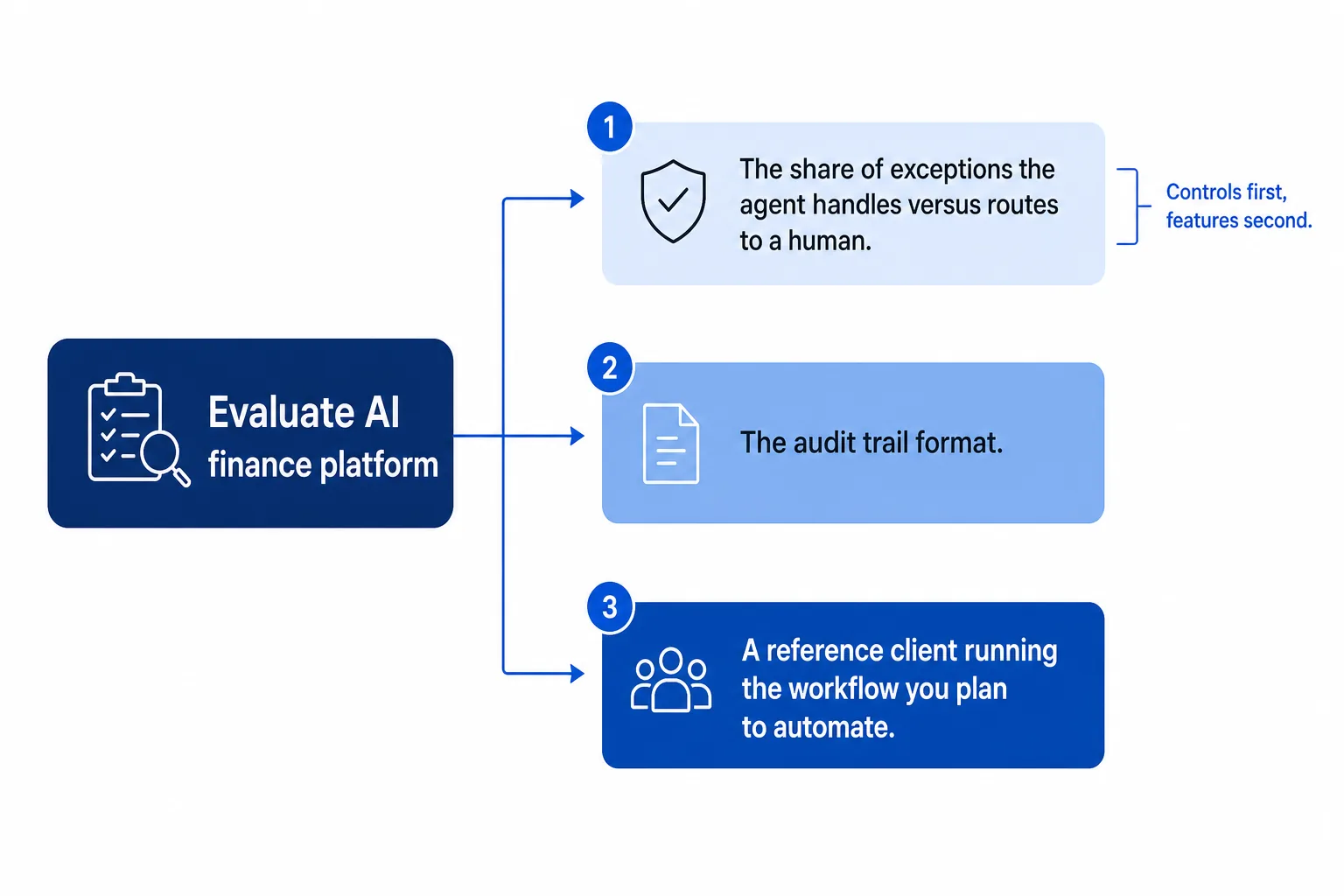
To evaluate an ai finance company, ask what decision the software makes without a person and where it stops. This applies whether you compare ai finance software, an ai platform for finance or ai finance apps. Ask each vendor for three things:
-
The share of exceptions the agent handles versus routes to a human
-
The audit trail format
-
A reference client running the workflow you plan to automate
The best ai for accounting and finance depends on transaction volume, existing approval layers and whether the workflow touches revenue recognition. No universal winner exists. A finance ai app built for consumers will not meet business audit needs, and many finance ai companies sell models without the workflow around them. Compare ai tools for finance and accounting on controls first and features second. For the build view, see our AI agents service.
Teams studying ai in corporate finance and the wider ai in the finance industry will find the same pattern: value follows clear rules, clean data and an approval gate. If you want to know how to use ai in finance without risk, begin with one workflow and one approver.
About tkxel
tkxel, a B2B software engineering and AI services company, builds finance agents through a phased method. Each engagement starts with one high-volume workflow, typically AP invoice matching or journal entry drafting, then expands into reconciliation and FP&A tasks. Every deployment includes an audit trail and a human approval gate designed with the finance team.
tkxel connects agent workflows to a client's existing ERP and accounting systems, so teams avoid a rebuild. We set a written baseline for hours spent on the chosen workflow before build starts, then measure the same workflow after launch. We do not promise a timing figure before that baseline exists.
Conclusion
The decision is not whether to adopt a finance ai agent. It is which single workflow to hand over first. Start with the task that has the clearest rules and the highest volume, usually invoice matching or recurring journal entries, and measure hours reclaimed before you expand. If a vendor cannot show the human approval gate in its workflow diagram, that is the disqualifier, not price or feature count.
Book a 15-minute call with tkxel's finance team. We will tell you the one workflow worth automating first.


