Services


Introduction
Most engineering teams don’t lose delivery speed because they care too much about quality. They lose speed because the quality problems surface too late, turning speed capacity into rework, release delays, and support escalations. Quality vs velocity in software engineering is the measurable tension between shipping software faster and maintaining defect standards tight enough to prevent avoidable production failures. It matters because as defect escape rate rises, support load, engineering rework, incident response time, and technical debt often increase disproportionately.
Teams spending 30-40% of sprint capacity firefighting production issues are not moving fast; they are running in place (Axify). This article gives you a severity-blast-radius ship/hold matrix, a three-path QA ROI model, and a CI/CD pipeline architecture that makes quality a structural property of your delivery process, not a debate before every release.
The direct answer: Engineering teams escape the speed-quality trap by tracking defect escape rate, automating quality gates across the delivery pipeline, and using a severity-blast-radius framework to make release decisions consistently instead of debating quality under deadline pressure.
Key Takeaways
- Velocity problems often start as quality-system problems. When teams spend too much sprint capacity on escaped defects, they are not moving faster; they are recycling effort.
- Defect escape rate helps reveal where the pipeline is leaking. The metric is most useful when viewed alongside support load, incident volume, and customer impact.
- Not every quality problem needs the same investment. Internal QA hiring, CI/CD automation, and external augmentation each solve different gaps, so the ROI depends on the team’s current maturity.
- Release decisions improve when risk is separated into severity and blast radius. This gives teams a clearer way to decide what can ship, what needs mitigation, and what should be held.
- Quality becomes easier to defend when it is tied to business impact. Boards are more likely to understand quality investment when it is framed through churn risk, support cost, and revenue-at-risk.
- CI/CD automation turns quality from a debate into a system. Automated checks, integration tests, and controlled rollouts make quality repeatable instead of dependent on last-minute judgment.
The false dilemma destroying engineering credibility
Speed and quality are not inherently opposing forces; with the right pipeline, feedback loops, and release controls, they can reinforce each other. The belief that you must sacrifice one for the other is how engineering leaders lose credibility with boards. They ship fast, bug rates climb, churn rises, and leadership freezes velocity to
fix quality,
losing two quarters of ground in the process.
The root cause is structural, not motivational. Teams that conflate speed with skipping quality gates enter what LinkedIn Pulse (2024) calls the efficiency trap: a state where organizations optimize for velocity at the expense of discipline, creating a compounding cycle that degrades output quality over time. Over time, new feature work becomes increasingly dependent on bug fixes, regression cleanup, and manual validation.
Breaking out requires a structural intervention, not a retrospective. The first move is measuring exactly where quality is leaking, and that starts with one number.
For teams scaling application development capacity, this structural clarity is not optional. Adding engineers to a broken quality pipeline amplifies defect output, not feature output.
The true cost of a bug depends on when you catch it
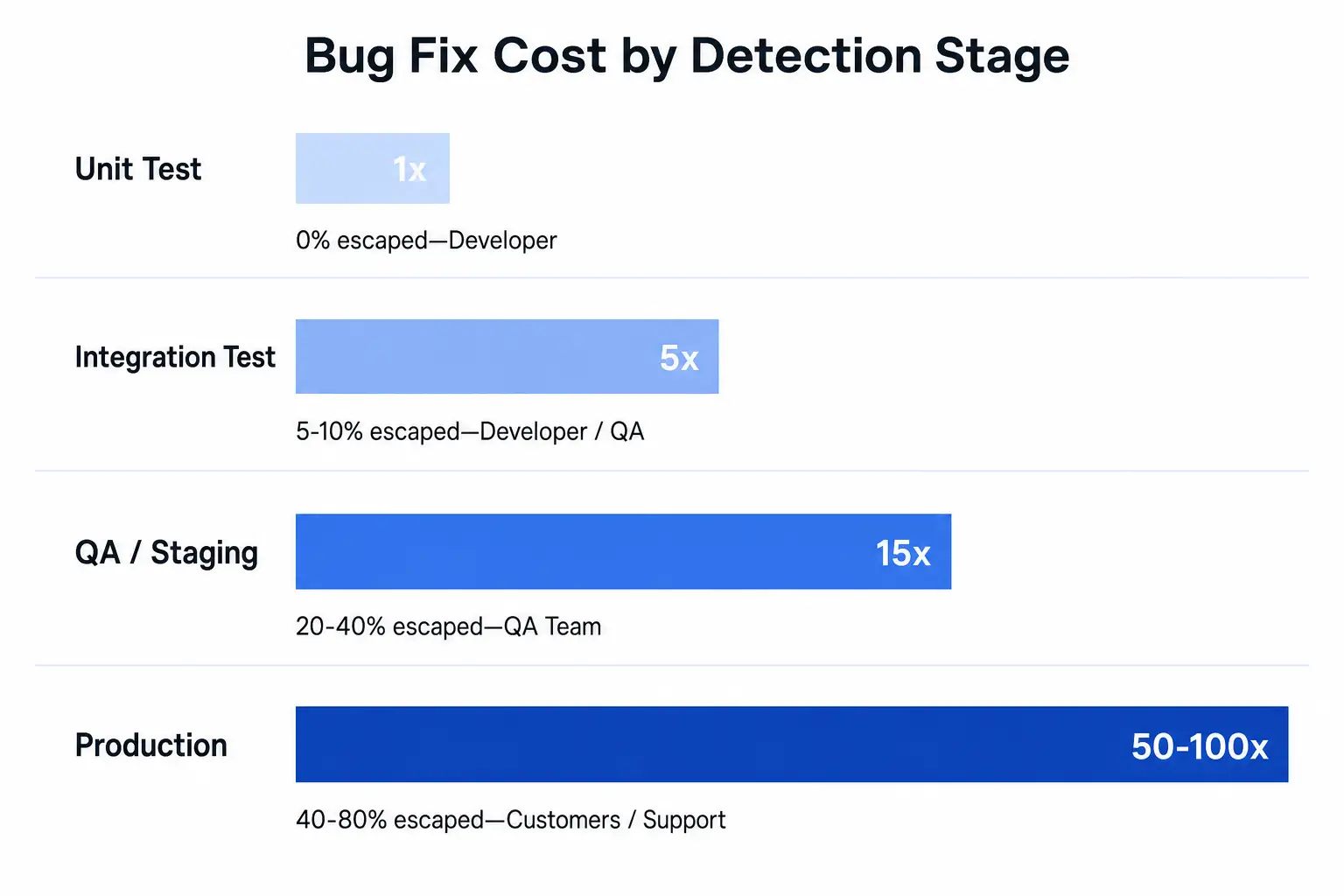
Bug escape rate (the percentage of defects discovered in production compared with defects found across the delivery lifecycle) is one of the most actionable quality metrics for engineering leaders. A 10% escape rate may sound manageable, but its business impact depends on defect severity, customer exposure, support burden, and recovery cost.
Bugs caught earlier are usually cheaper to fix because the context is fresh and the affected surface area is smaller. A defect caught in production can become many times more expensive when it triggers support tickets, incident response, rollback work, customer impact, or engineer context-switching.
| Detection Stage | Relative Fix Cost | Typical Escape Rate | Who Finds It |
|---|---|---|---|
| Unit Test | Lowest | 0% escaped | Developer |
| Integration Test | Low to moderate | 5–10% escaped | CI pipeline |
| QA / Staging | Moderate to high | 10–20% escaped | QA engineer |
| Production | High | 15–35% escaped | Customer |
This table tells you exactly where to invest. If your team has no automated unit or integration test coverage, production bugs are more likely to trigger avoidable support load, incident response, rollback work, and engineering rework.
That single data point reframes the ROI model for CI/CD automation entirely.
The action threshold: a sustained bug escape rate above 15% should trigger a review of your pre-production quality layer, especially if support tickets, incidents, or customer-reported defects are rising at the same time. Shipping faster into a weak quality pipeline can compound defects, increase rework, and reduce the effective capacity available for new feature development.
Three paths to better quality, one ROI model
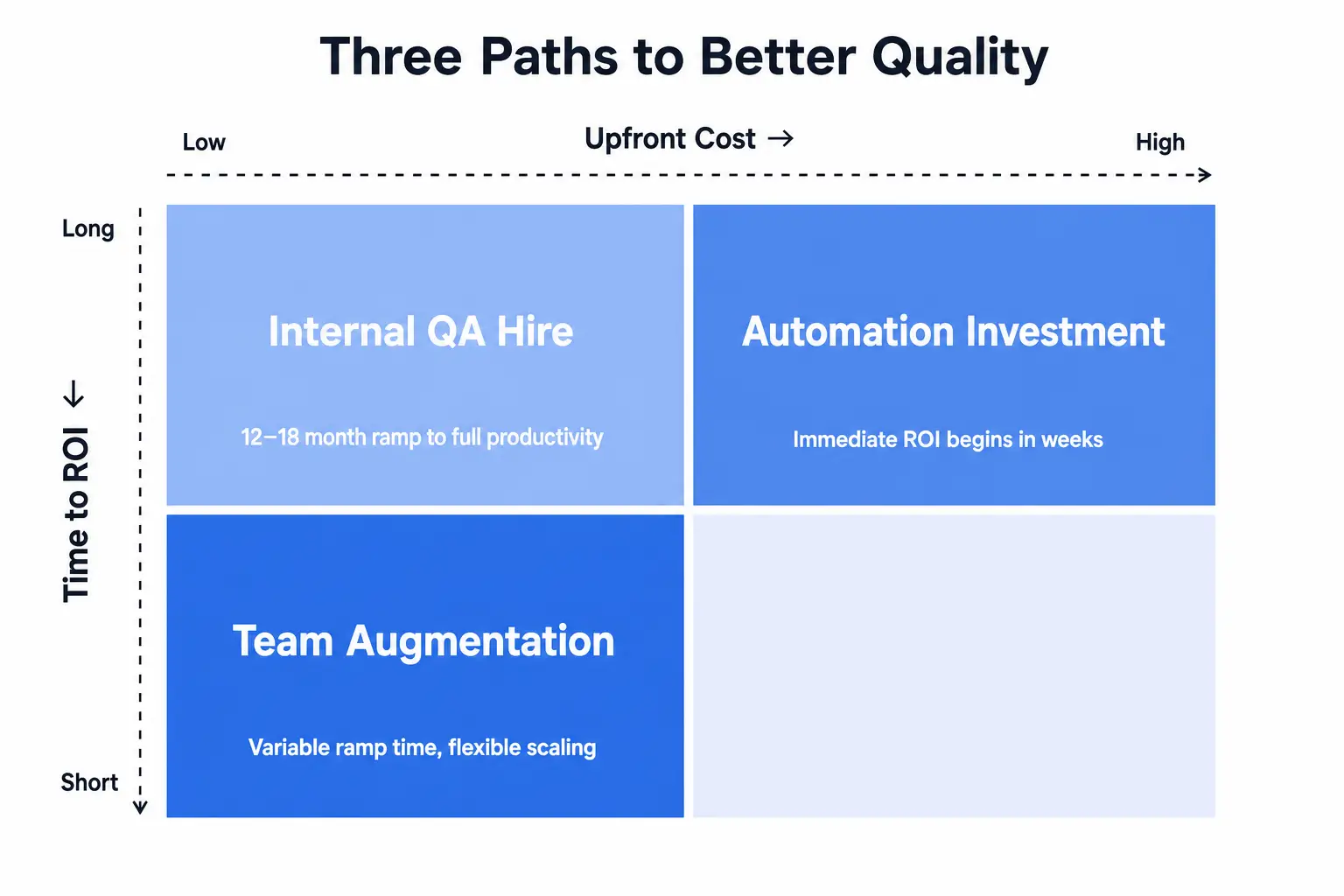
Engineering leaders facing a quality problem typically consider three responses: hire internal QA engineers, invest in automation, or augment with an external team. Each carries a distinct return profile, and choosing without modeling the ROI produces the wrong answer most of the time.
Internal QA hires can carry a meaningful ramp cost before reaching full productivity, especially when the codebase is undocumented, test coverage is low, or release processes are inconsistent. Salary, onboarding, tooling, and management overhead make this the highest upfront investment. The payback period stretches further when your test coverage baseline is low, because new hires often spend their early months building foundational tests and learning release risks before they can consistently prevent release-blocking defects.
CI/CD automation can pay back within a few quarters when release frequency is high, incident costs are measurable, and the team already has enough test coverage to automate meaningful regression gates. In many teams, even a single production incident can cost more in engineering time, support effort, and customer disruption than the monthly cost of basic CI/CD infrastructure. The business case becomes stronger as release frequency and incident volume rise.
Team augmentation via external specialists usually works best for a specific release cycle, a defined coverage gap, or a clearly scoped modernization effort. It becomes risky when organizations treat it as a permanent substitute for internal quality infrastructure, documentation, and ownership. The failure mode is predictable: augmented teams inherit an undocumented codebase, move slowly during ramp-up, and exit before institutional quality knowledge transfers back to the core team.
The sequencing that works: automate first on your highest-traffic code paths, use augmentation to close specific coverage gaps, then evaluate whether the residual quality gap justifies an internal hire. Teams considering application re-engineering to modernize legacy pipelines find this sequencing especially important; the re-engineering effort itself creates a window to instrument quality gates that were never present in the original codebase.
CI/CD automation as the structural link between quality and speed
CI/CD automation is the mechanism that makes quality a property of the pipeline rather than a dependency on human discipline. When quality gates run automatically on every commit, teams stop debating whether to run tests before shipping. The pipeline enforces the answer.
DevOps testing practices embedding continuous quality checks throughout the pipeline, rather than staging them as a single gate at the end, reduce defects reaching production (Ranorex). Feedback arrives when the code change is still small and the author’s context is still fresh. Rework cycles shrink.
A practical pipeline architecture for improving both velocity and quality often includes four layers in sequence.
- Static analysis should run early, ideally on every commit or pull request, and complete quickly enough that developers do not bypass it. It catches syntax errors, security anti-patterns, and code style violations before human review begins.
- Unit tests should run on every pull request, with strong coverage on critical paths, meaningful assertions, and regression tests for previously escaped defects. Completion time should stay short enough to preserve fast feedback.
- Integration tests run on merge to main, validating service contracts, database interactions, and third-party API dependencies.
- Canary deployment can control production traffic exposure incrementally, while blue-green deployment enables fast rollback by switching traffic between two production-ready environments when error rates, latency, or business-critical metrics move outside acceptable limits.
Two structural code review changes amplify this pipeline. First, set a 24-hour maximum review turnaround; reviews sitting for 48-72 hours can increase effective delivery cost through context loss, merge conflicts, and delayed feedback.
Second, automate style enforcement so senior engineers spend review cycles catching logic errors, not formatting issues. The best-in-class developer tools, including CI/CD tooling, are the top contributor to software delivery success because they improve productivity, visibility, and coordination (McKinsey).
A practical framework for the ship/hold decision
The ship/hold decision is where quality vs velocity becomes concrete. Most teams make it informally, under political pressure, with no documented rationale. Formalizing it into a two-variable matrix removes pressure and reduces decision time.
The two variables are bug severity (functional impact: does the bug block a core workflow, degrade performance, or create a minor inconvenience?) and blast radius (how many users are affected: a single account, a user segment, or the full user base?).
Map these onto four quadrants and the decisions become systematic.
- Low severity, low blast radius: ship with passive monitoring; address in the next sprint.
- Low severity, high blast radius: ship behind a feature flag only if rollback is safe, no data corruption risk exists, and monitoring can detect impact quickly.
- High severity, low blast radius: isolate the affected account, segment, or workflow if possible; otherwise hold the release until the defect is fixed or safely mitigated.
- High severity, high blast radius: full hold; this is your rollback or hotfix scenario.
This framework answers the ICP question engineering leaders face most often: which bugs are worth catching pre-production, and which can be addressed post-release with fast rollback? Severity combined with blast radius provides a repeatable decision framework, while reversibility and customer impact determine how much risk the team can safely accept.
The board communication version is simpler. Translate blast radius into revenue-at-risk. A critical bug affecting your top enterprise accounts is not just a defect count; it is a revenue-at-risk, retention, and account-health problem. That framing gets remediation budget approved in a single conversation.
Common failure modes when teams try to fix this
Most quality improvement initiatives stall before they deliver measurable results. Four failure patterns account for the majority of cases.
Failure mode 1: canary deployment without upstream gate stability. Teams add production safeguards before fixing the test suite. The canary catches defects that earlier automated tests, integration checks, or staging validation should ideally have blocked. Infrastructure spend increases; defect rates do not fall.
Failure mode 2: outsourced QA without knowledge transfer. External teams may close a gap for one release cycle, but if knowledge transfer, documentation, and test assets are not built into the engagement, the internal team can inherit the same quality problems after the engagement ends.
Failure mode 3: debt deferral framed as velocity. Teams skip debt resolution during a growth sprint, onboard new engineers into an undocumented codebase, and watch ramp-up time double. New hires introduce defects by misunderstanding existing constraints. The short-term velocity gain often disappears as onboarding slows, rework rises, and new engineers spend more time discovering hidden system constraints.
Failure Mode 4: quality culture as enforcement-only. When quality gates feel punitive rather than protective, engineers route around them. The structural fix is pairing every gate with tooling that removes manual effort: automated linting eliminates style review burden, automated test scaffolding reduces writing overhead, and clear severity frameworks remove political pressure from release decisions.
When engineers see quality infrastructure as something that protects their time rather than consuming it, adoption follows. Track rework hours per sprint as a team-visible metric. When rework drops, the culture shift becomes self-reinforcing.
Working With tkxel
tkxel, a B2B software engineering and AI services company, embeds quality engineering directly into delivery from sprint one. The approach starts with a pipeline audit: mapping your current defect escape rate by detection stage, identifying the highest-cost leakage points, and designing automated quality gates that fit your existing toolchain without requiring a full re-platform. This is not a methodology handoff. tkxel engineers own implementation alongside your team until the metrics move.
The outcomes are measurable. tkxel’s DevOps practice has delivered 60% faster deployment cycles through CI/CD automation, with 40% reductions in cloud infrastructure costs through governance and optimisation work. Engineering teams engaging tkxel for quality and pipeline modernisation consistently report sprint velocity increases within two quarters, because defect rework stops consuming the capacity that would otherwise go to new features.
If your bug escape rate remains above 15% across multiple releases, or your team spends more than 20% of sprint capacity on rework, that is a strong starting point for a productive conversation.
Conclusion
The quality vs velocity tradeoff is often a symptom of missing infrastructure, weak feedback loops, or unclear release-risk decisions, not an unavoidable constraint. Teams that measure bug escape rate rigorously, invest in CI/CD automation before scaling headcount, and use a severity-blast-radius matrix for every release decision discover that quality and velocity reinforce each other. The engineering leaders who reach that state earliest build the most durable competitive advantage: their teams ship fast and land clean, consistently.
The next step is concrete. Pull your last three months of production defects, classify each by severity and blast radius, and calculate your actual bug escape rate. That number tells you exactly where to invest next.
Work with tkxel’s engineering team to get a pipeline assessment scoped to your stack and release cadence.