Services


Introduction
Finance leaders have already answered the adoption question. The harder question is what happens after a forecasting pilot works and the board asks for it everywhere. Most teams scale the model first and discover, months later, that their approval chain was never built for machine-generated output. This article lays out the controls-first sequence mid-market finance teams use to scale AI financial forecasting without rebuilding governance from scratch.
Scaling AI financial forecasting without losing control means extending a working pilot across business units while every output still carries its own audit trail and a named approval owner. That one sentence is the entire framework this article unpacks.
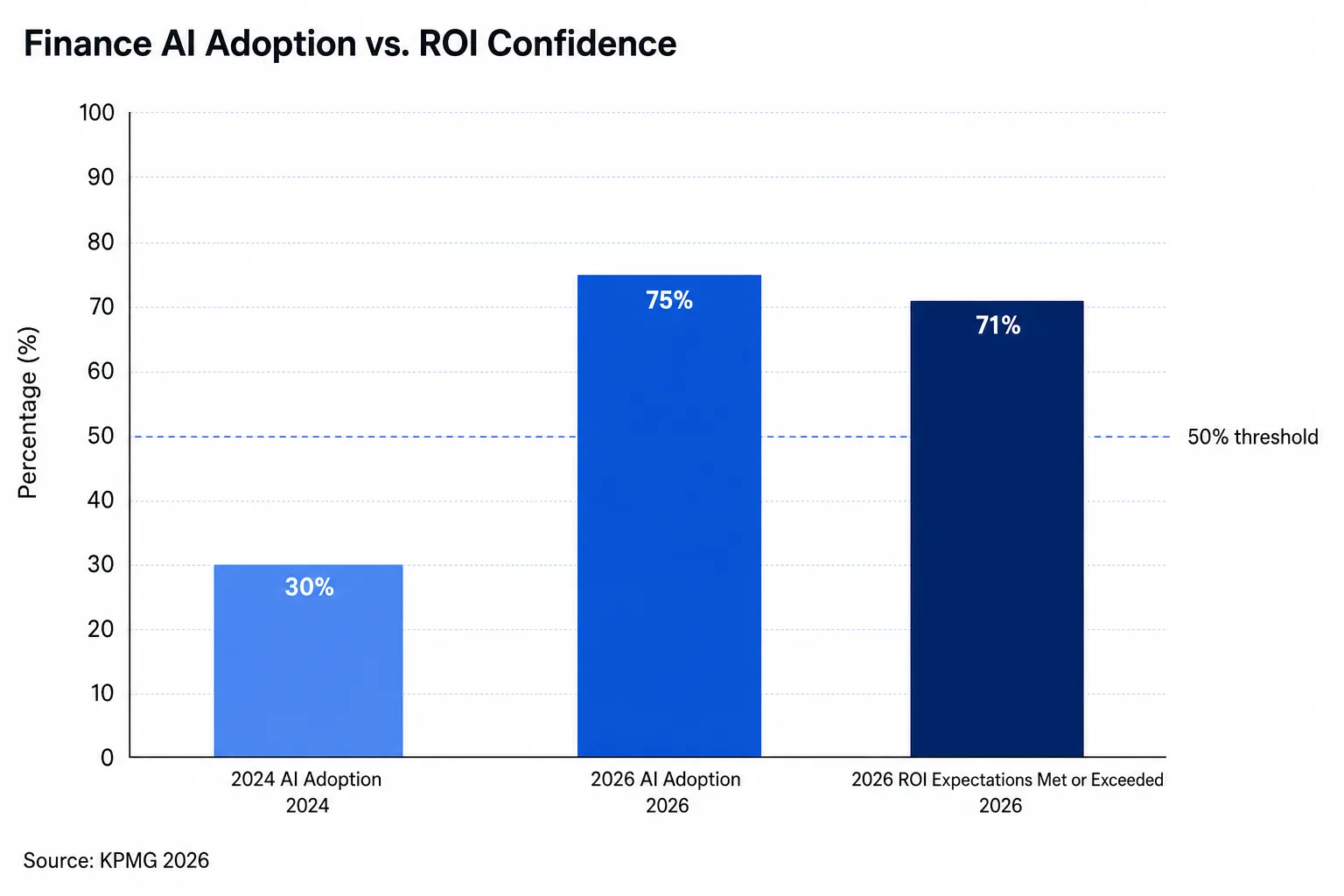
Pilots stall because teams scale the model before they scale the controls around it. Active AI use in the finance function has moved from 30 percent to 75 percent in two years, per KPMG (2026). That curve looks like clean progress until you ask how many of those deployments run in one business unit versus across the enterprise.
The business case is not the obstacle. 71% of companies report their finance functionu2019s AI initiatives are meeting or exceeding their ROI expectations, according to KPMG. That number should close the debate for any CFO still asking whether AI financial forecasting pays for itself.
However, adoption does not automatically translate into impact. In a 2025 survey of 183 CFOs, Gartner found that 84% of finance organizations had implemented or planned to implement AI, yet only 7% reported a high or very high impact. These findings cover finance AI broadly, reinforcing the need to measure the results of each forecasting rollout.
The real obstacle is structural. Pilots get built with one approver, one data source and no formal exception path. Scale adds multiple business units, multiple data owners and auditors who never sat in on the pilot. Most vendor content frames this gap as a platform problem and recommends swapping legacy systems for cloud infrastructure. That framing misses the actual blocker: the controls, not the infrastructure, are what break first.
Key Takeaways
- Map every AI financial forecasting output to a named approval owner before adding a second business unit.
- Require an audit trail export for every AI-generated forecast, not just the final numbers, so internal audit signs off before external auditors ask.
- Set a 90-day checkpoint after each new unit goes live to confirm ROI holds as volume increases.
- Pilot one bounded agentic AI use case, such as cash flow forecasting, before connecting agents across record-to-report and FP&A.
- Build exception routing into the workflow from day one so unusual transactions reach a human reviewer automatically.
What a Controls-First AI Adoption Framework Looks Like
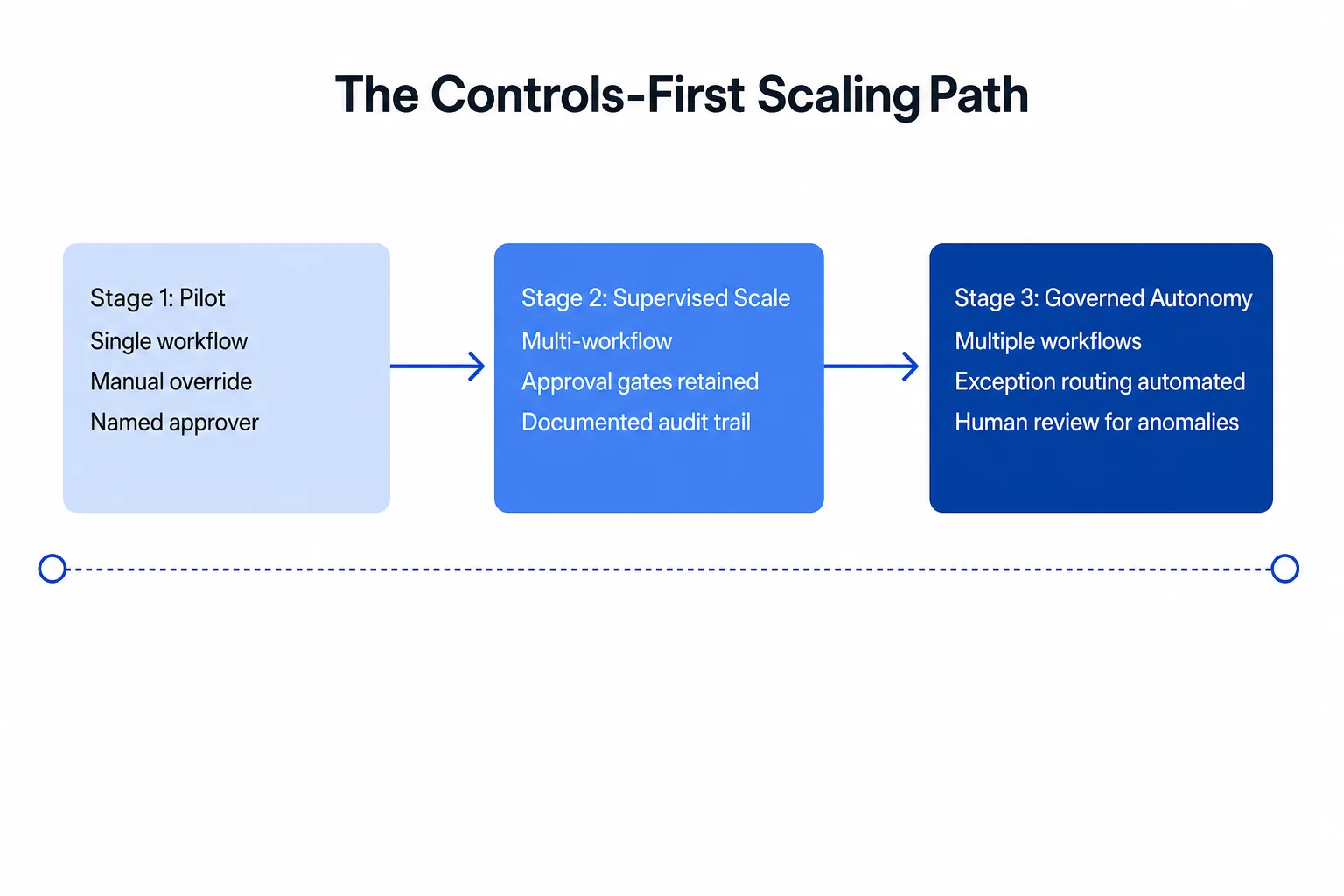
A controls-first framework for AI financial forecasting assigns a named approval owner to each forecast, requires an exportable audit trail, and establishes a 90-day checkpoint after each rollout to assess ROI and control effectiveness.
The framework runs in three stages. Start with a pilot: lock down one forecasting workflow, assign one named human approver and build a manual override into every output. Do not move to the next business unit until this stage runs clean for a full reporting cycle.
Stage two extends the same workflow to two or three business units. Approval gates stay intact and every forecast carries a documented audit trail. Stage three connects multiple workflows and automates exception routing, reserving human review for flagged anomalies rather than every output.
Teams that skip stage two and jump straight to stage three are the ones rebuilding governance under audit pressure later. Our Accounts & Finance team maps controller sign-off requirements before the second business unit ever touches the system, so the roadmap and the audit requirements stay on the same page from day one.
Where the Manual Work Still Hides and Why It Matters for Forecasting
Manual work still hides inside the month-end close, and that bottleneck undermines financial forecasting accuracy upstream. Much of the repetitive work, data entry, transaction categorization, reconciling numbers, is still being done manually, according to reporting from CFO Dive. If the close is manual, the forecast built on top of it inherits every delay and reconciliation error.
Forecasting AI does not operate in isolation. It consumes close data, categorization logic and reconciled figures as inputs. A forecasting model layered on top of a manual close is automated on the output side while the input side stays the same bottleneck it always was.
Our AI in Automation vs Traditional Automation in Month-End Close analysis breaks down why rule-based bots fail on exceptions while AI-driven close automation handles unstructured data without manual intervention. Fixing the close first is not a detour from scaling financial forecasting. It is the prerequisite.
How Agentic AI Use Cases Fit Into Forecasting at Scale
To scale financial forecasting across business units without losing oversight, deploy specialized agents instead of one model making every decision. Agentic AI use cases assign each agent a discrete task, such as variance detection, approval routing or anomaly flagging, and each agent produces its own inspectable audit log.
This architecture is what makes stage three viable without sacrificing control. A single large model making every forecasting decision is a governance liability because controllers cannot inspect a black box. Specialized agents give them something concrete to review instead.
Research from EY (2025) found that teams applying AI to FP&A saw faster, more accurate forecasts. Agentic architecture is what lets that speed and accuracy scale across business units without each new deployment triggering a fresh governance review from scratch.
AI Forecasting Scaling Approaches Compared
The table below compares three approaches to scaling AI forecasting on deployment speed and audit readiness.
| Approach | Time to multi-unit deployment | Audit trail completeness at stage one | Human review coverage by final stage |
|---|---|---|---|
| Pilot-first, governance later | 2-4 months to deploy, 6-9 months to retrofit controls | 0%, built only after audit findings | Low until retrofit is complete |
| Platform-first modernization | 9-12 months due to legacy migration | Not built in, depends entirely on new platform’s native controls | Medium, unchanged from pilot stage |
| Controls-first (three-stage) | 4-6 months to stage two, 8-10 months to stage three | 100% from stage one onward | High, with automated exception routing by stage three |
Note: tkxel delivery estimates, illustrative. Actual timelines and control coverage may vary depending on implementation scope and requirements.
Platform-first modernization looks attractive because it promises a clean technical foundation. In practice it delays the forecasting win by nine to twelve months while the migration runs its course, and it still leaves the controls question unanswered.
Building the Board-Ready Business Case for Scaling
Boards do not approve vague automation initiatives. They approve named workflows with measurable risk controls attached, so lead the business case with the specific financial forecasting workflow, the adoption trajectory and the control gate for each stage.
The gap between ambition and deployment also appears in Deloitteu2019s finance research. Citing its Q4 2025 CFO Signals Survey, Deloitte reported that 87% of CFOs believed AI would be extremely or very important to their departmentu2019s operations in 2026, while only 63% had deployed AI solutions. For a forecasting business case, this makes a clear implementation sequence useful alongside the projected ROI.
Mid-market teams that get stuck at the business-case stage usually have the ROI numbers but not the control narrative. Our Advisory & Strategy engagements build that control narrative alongside the ROI case, because a board that approves scale without understanding the approval gates is approving a future audit finding.
About tkxel
tkxel, a B2B software engineering and AI services company, maps the audit trail and approval structure before writing a single line of financial forecasting logic. A model that cannot survive an audit review is not production-ready, so controls get designed as architecture, not bolted on as compliance paperwork later.
We have architected multi-agent systems that automate end-to-end operational workflows across procurement, recruitment and real estate leasing, each one built with auditable decision trails instead of opaque automation. That same discipline carries into forecasting: specialized agents for variance detection, approval routing and exception handling, each producing its own audit log so the controller sees exactly what the system decided and why.
Conclusion
Scaling AI financial forecasting is a controls problem, not a modeling problem. Most mid-market finance teams discover this only after their pilot succeeds and someone asks to roll it out further. Adoption data is strong and ROI confidence is close to universal, but neither answers the question a controller asks first: where is the audit trail, and who approves exceptions.
The sequence in this article gives you the answer: pilot with manual override, supervised scale with intact approval gates, then governed autonomy with automated exception routing. Skip the middle stage and you rebuild governance under audit pressure later, at a far higher cost than building it in from the start.
If your forecasting pilot is stalled waiting on board approval, or you are weighing whether to fix close automation before scaling financial forecasting, schedule a 15-minute conversation with our finance automation team. We will map your first 90 days and tell you whether controls-first scaling or close automation should come first.