Services


Introduction
Key person risk is the operational and financial exposure a business faces when one or two engineers hold knowledge, access, or capability that no one else can replicate. Many non-technical CEOs may not recognize this risk until a key employee resigns or becomes unavailable, taking months of undocumented institutional knowledge with them. Losing a senior engineer without a succession plan can create material financial exposure across recruiting, onboarding, lost delivery velocity, emergency contractor coverage, and customer impact. The scenario model below illustrates how those costs can add up under conservative, moderate, and high-risk assumptions.
This article provides a practical risk matrix, an illustrative financial model, and a 90-day mitigation roadmap designed for non-technical leaders, with engineering input where technical validation is required.
Only 16% of executives feel comfortable with the amount of technology talent available to drive digital transformation, while 60% cite tech-talent scarcity as a key inhibitor. (McKinsey)
Risk can arise when one employee’s absence could halt operations, delay revenue, or increase the risk of compliance failure. If your team cannot ship or support a critical system without one specific engineer, you likely have meaningful key-person exposure that a structured mitigation plan can help reduce.
Key Takeaways
- A simple four-question dependency audit can help leadership identify which engineering roles create the highest business-continuity risk before those risks become urgent.
- High-risk roles should have a designated knowledge partner so critical systems are no longer understood or operated by only one person.
- Documentation is more effective when it becomes part of the delivery process, rather than a separate cleanup task that gets postponed.
- A practical resilience metric is the percentage of critical systems with a backup operator who has completed an independent task within the last 90 days.
- Dependency scores can inform compensation, retention, and workload-planning discussions, especially when individual engineers are carrying disproportionate operational risk.
Why non-technical leaders consistently underestimate this risk
Businesses can accumulate technical knowledge silos faster than leadership recognizes, particularly when early hiring decisions prioritize execution speed over redundancy. A startup hires one exceptional backend engineer. That engineer builds the payment system, the API integrations, and the deployment pipeline. Three years later, they are the only person who understands any of it. No documentation exists. No one else has ever touched that codebase.
This pattern compounds as the business grows. The more critical a system becomes to revenue, the more dangerous the concentration of knowledge around it becomes.
A common pattern is that a company scales from $1M to $5M ARR with a substantial share of technical delivery concentrated among two or three exceptional engineers. Leadership may reward their output without fully recognizing the structural dependency being created. If one of those individuals leaves, recovery could take several months, depending on system complexity, documentation quality, and available backup capacity.
Teams that made developer productivity measurable reported 20–30% fewer customer-reported defects, a 20% improvement in employee-experience scores, and a 60-percentage-point improvement in customer satisfaction. (McKinsey)
98% of IT organizations report digital transformation challenges, and 72% say their systems are overly dependent on one another. (Salesforce)
How to map and measure key person dependencies before they cost you
Non-technical leaders can initiate key-employee dependency mapping by asking four consistent questions across every critical role, although engineering input is important when validating the answers.
For each engineer or technical lead, ask:
- If this person was unavailable for 30 days, which business functions would stop completely?
- Does written documentation exist for the systems this person manages?
- Has anyone else on the team operated those systems independently in the last six months?
- Could a new hire reach 80% productivity in this area within 90 days using only available documentation?
Score each answer from 1 to 4, where 1 represents low dependency risk and 4 represents high dependency risk. Under this illustrative framework, a total score of 5–8 places the role on the Watch List, while a score of 13–16 places it in the Crisis Zone and indicates that prompt mitigation planning should begin.
The dependency risk matrix
| Risk Level | Score Range | Recovery Time | Business Impact | Priority Action |
|---|---|---|---|---|
| Monitor | 1-4 | Under 2 weeks | Minimal disruption | Quarterly documentation review |
| Watch List | 5-8 | 2-6 weeks | Moderate slowdown | Assign documentation sprint |
| Priority Action | 9-12 | 6-16 weeks | Severe operational gaps | Begin cross-training immediately |
| Crisis Zone | 13-16 | 4-6+ months | Business continuity threat | Escalate to leadership; act within 30 days |
Any engineer scoring in the Crisis Zone may surface as an operational risk during M&A or investor diligence, where buyers assess risks, mitigation options, and valuation considerations. The score is not a performance evaluation. It is a business continuity measurement.
The real financial cost of technical knowledge concentration
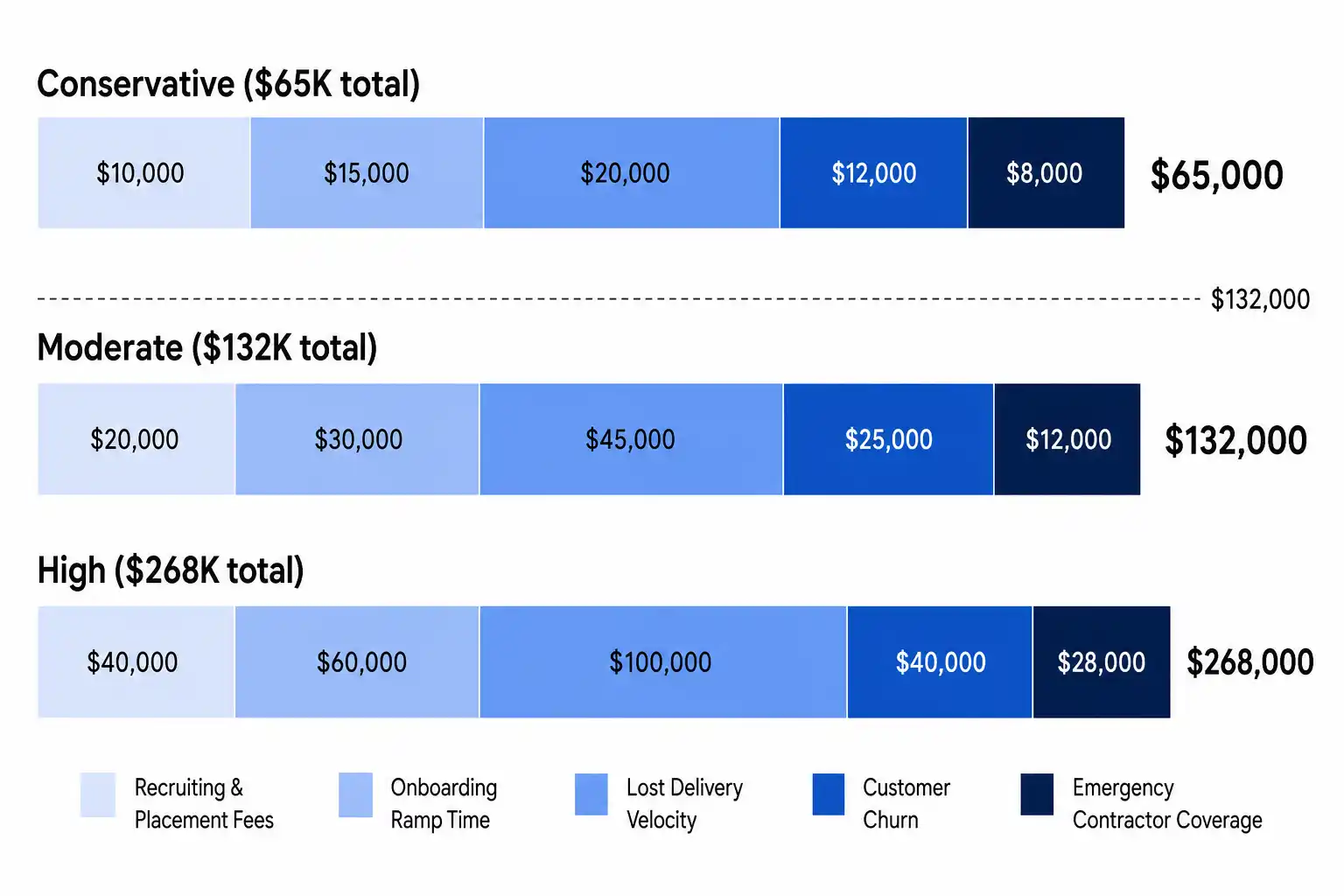
Most non-technical leaders model the wrong number when they think about engineer turnover. They see the salary cost of replacement. They rarely model the full cascade of costs across recruiting, productivity loss, and customer impact.
Here is an illustrative scenario model showing how several categories of turnover-related cost could accumulate. These figures are illustrative scenario assumptions, not industry benchmarks, guarantees, or forecasts. Actual costs vary based on compensation, recruiting conditions, system complexity, customer exposure, documentation quality, available backup capacity, and recovery time.
| Cost Category | Conservative | Moderate | High | |
|---|---|---|---|---|
| Recruiting and placement fees | $15,000 | $25,000 | $45,000 | |
| Onboarding ramp time (90-180 days) | $20,000 | $40,000 | $65,000 | |
| Lost delivery velocity (per sprint, ongoing) | $8,000 | $15,000 | $28,000 | |
| Customer churn from degraded support | $10,000 | $30,000 | $80,000 | |
| Emergency contractor coverage | $12,000 | $22,000 | $50,000 | |
| Total estimated exposure | $65,000 | $132,000 | $268,000 |
One of the most important rows is
A phased roadmap to reduce technical knowledge silos
Reducing siloed engineering expertise does not happen through a single documentation sprint. It requires a sequenced plan with clear ownership and measurable checkpoints.
Phase 1: Diagnose (Weeks 1 to 4)
Run the dependency audit using the four questions above. Score every critical engineering role. Plot each on the risk matrix. Identify your top three Crisis Zone risks. This is your baseline. Company-approved AI tools can help structure and analyze this process. Using non-sensitive team information, role descriptions, and answers to the four questions, leaders can ask the tool to identify scoring patterns or potential gaps across roles.
This may reduce the time required for initial analysis, depending on the completeness and quality of the information provided. Involve your engineers directly. Tell them the goal is to reduce pressure on them, not evaluate their performance. Engineers who carry concentrated institutional knowledge may feel constrained or overburdened by it. When handled well, this conversation may help reduce some of that pressure.
Phase 2: Document (Weeks 5 to 8)
For each Crisis Zone role, assign a two-week documentation sprint. Use Confluence, Notion, or a similar knowledge platform. The goal is not perfect documentation. The goal is enough documentation that a capable engineer could orient themselves without calling the original author.
Each runbook should cover: system purpose, architecture in plain language, access and rotation protocols, common failure modes, recent changes, and escalation contacts. Organizational silos were the most-cited barrier to effective knowledge management, cited by 55% of respondents, followed by lack of incentives at 37% and lack of an organizational mandate at 35%.
This is why documentation should be simple, searchable, and embedded into the team’s normal workflow rather than treated as a one-off cleanup task. (Deloitte)
Company-approved AI tools such as Claude, Copilot, or Notion AI may help create an initial runbook draft from an engineer’s walkthrough, approved repository content, or structured notes. The time required will depend on system complexity, available inputs, security restrictions, and the quality standard expected. AI may reduce the effort involved in producing a first draft, but the system owner must still review the documentation for accuracy, completeness, and operational safety. When planning the sprint, prioritize protected engineering attention and validation rather than assuming that drafting time will be the only constraint.
Phase 3: Cross-train (Weeks 9 to 12)
Assign a knowledge partner to each high-risk role. A knowledge partner is a second engineer who shadows the original, reviews the documentation, and completes at least one independent task in the critical system within 90 days. AI tools can compress this ramp-up meaningfully: the knowledge partner can use an AI to generate Q&A sessions from existing runbooks, simulate failure-mode scenarios, or get plain-language explanations of unfamiliar code sections. AI-assisted self-study may allow the knowledge partner to begin orientation earlier and reserve more of the senior engineer’s time for review, validation, and edge-case walkthroughs. Direct knowledge transfer and supervised practice will still be necessary for critical systems.
Focus on Crisis Zone roles first. Successfully cross-training a high-risk critical system may deliver greater risk reduction than prioritizing several lower-risk documentation updates.
For teams where internal cross-training capacity is genuinely limited, legacy system modernization with an external partner can simultaneously reduce system complexity and eliminate the knowledge concentration problem at its root.
How to have the conversation without threatening your engineers
Non-technical leaders avoid this conversation because they fear appearing to evaluate performance or create job insecurity. That instinct is understandable. It is also wrong.
Some engineers who hold concentrated knowledge may feel constrained by it. They may find it difficult to disconnect fully during leave and may be pulled into incidents that other team members are not yet equipped to handle. When framed appropriately, this conversation can emphasize relief and shared ownership rather than suggesting that the engineer’s value or position is being reduced.
Frame the conversation around three points:
- You want to remove the burden of exclusive system ownership from them, not redistribute their value.
- Documentation and cross-training will expand their scope for growth, not shrink their influence.
- This is a business continuity investment in which they are the most important partner.
The same principle applies outside engineering: when one person is the only trained operator for a critical function, the organization should certify backups, diversify responsibility, and design systems that can tolerate absence. The advice was direct: certify others, diversify responsibility, and build systems designed for absence. The same logic applies to engineering teams at any scale.
Keep the first conversation to 20 minutes. Ask them which systems they find most stressful to own exclusively. Let them identify the highest-risk areas. You will often find they have already been worried about this for months.
Conclusion
The businesses that handle key person risk well are not the ones with the largest engineering teams. They are the ones whose leaders asked the hard questions early, built documentation systems before they needed them, and treated knowledge resilience as a business asset rather than an HR checklist.
Run the dependency audit this week. Score your engineers against the risk matrix. Build the 90-day roadmap with your engineering lead. Then track the percentage of critical systems with a backup operator as a standing leadership metric, reported monthly alongside velocity and uptime.
For organizations scaling their engineering teams, connecting resilience planning to a data-driven transformation strategy ensures knowledge architecture grows alongside data architecture, keeping both visible and governed.
If your audit reveals Crisis Zone dependencies that need external support to resolve, tkxel can help you assess the risk, modernize the systems creating the concentration, and build the engineering practices that prevent the problem from returning.
Book a 15-minute assessment call with tkxel today to identify your highest-risk dependency and tell you the one thing worth addressing first.